





The Challenge: Too Much Work, Not Enough Time
Imagine a growing company with 50 employees.
Business is increasing, but the company is experiencing a familiar problem: employees are spending too much time doing repetitive work instead of productive work.
Employees may spend hours each week:
- Writing emails
- Creating reports
- Entering and organizing information
- Responding to common customer questions
- Creating marketing content
- Preparing documents
- Researching information
- Updating spreadsheets
- Creating social media posts
- Summarizing meetings
- Repeating the same administrative processes
None of these tasks are necessarily difficult—but together, they can consume a significant amount of employee time.
The company wants to increase production without simply adding more employees.
That’s where AI can become part of the solution.
The AI-Powered Approach
Instead of replacing employees, the company introduces AI as a productivity tool that helps employees complete certain tasks faster.
The objective isn’t simply:
“Use AI because AI is popular.”
The objective is:
Use AI to reduce repetitive work so employees can spend more time on work that requires human judgment, creativity, communication, and decision-making.
The company identifies several areas where AI could assist.
1. AI Helps Create Content Faster
The marketing team previously spent hours creating promotional content.
AI can help employees generate initial drafts for:
- Blog articles
- Product descriptions
- Email campaigns
- Social media posts
- Advertisements
- Promotional messages
- Headlines
- Marketing ideas
Instead of starting with a blank document, employees can begin with an AI-generated draft and then review, edit, and improve it.
Before AI
Idea → Research → Draft → Rewrite → Edit → Final Content
With AI Assistance
Idea → AI Draft → Human Review → Edit → Final Content
The employee remains responsible for the final content, while AI helps accelerate the early stages.
2. AI Assists Customer Support
Customer service employees often receive repetitive questions.
For example:
“What are your business hours?”
“Where is my order?”
“How do I reset my password?”
“What is your return policy?”
AI can help identify common questions and provide suggested responses based on approved company information.
Employees can then review the response before sending it when human approval is appropriate.
This can allow customer service representatives to spend more time handling complex customer problems instead of repeatedly answering simple questions.
3. AI Can Accelerate Research
Employees frequently spend time searching through documents, websites, reports, and internal information.
AI can assist by:
- Summarizing lengthy documents
- Extracting important information
- Organizing notes
- Comparing information
- Creating research summaries
- Identifying frequently mentioned topics
- Turning unstructured information into organized drafts
Instead of spending an hour manually organizing information, an employee may be able to use AI to create an initial summary and then verify the important details.
4. AI Can Help Employees Create Reports
Imagine a sales department that needs a weekly report.
Previously:
Collect data → Organize data → Analyze → Write report → Format → Review
With AI-assisted tools:
Collect data → AI assists with organization and draft analysis → Employee verifies → Final report
AI isn’t necessarily making the business decision.
Instead, it helps employees get from raw information to a usable report faster.
5. AI Can Support Marketing Production
Marketing teams can use AI to turn one idea into multiple pieces of content.
For example:
One promotion
“20% off this weekend.”
AI could help create:
- Website promotion
- Coupon listing
- Facebook post
- Instagram caption
- TikTok concept
- Email campaign
- Blog content
- Promotional headline
- Short video script
The marketing team can then review each piece and adjust it for the company’s brand.
This creates an important productivity advantage:
One idea → Multiple marketing assets
Instead of creating everything independently, the team can use AI to help transform a single campaign concept into multiple deliverables.
6. AI Agents Can Connect Multiple Tasks
The next stage goes beyond simply asking an AI chatbot a question.
AI agents are being developed to assist with multi-step workflows.
For example:
Employee:
“Create a promotional campaign for our weekend restaurant special.”
An AI-powered system could potentially assist with:
- Understanding the promotion
- Creating campaign messaging
- Creating a coupon description
- Drafting social media content
- Creating an email
- Creating a short video script
- Organizing the campaign
- Preparing the materials for review
The employee can then review the campaign before anything is published.
This changes the role of AI from simply answering questions to helping employees complete workflows.
The Productivity Impact
Consider a hypothetical example.
That’s:
20 × 5 = 100 hours per week
If improved workflows eventually reduce that workload by even 30%, the company could potentially recover approximately:
30 employee-hours per week
That’s the equivalent of gaining additional productive capacity without hiring another employee.
Important
This is an illustrative calculation, not a guaranteed result. Actual productivity improvements depend on the company’s processes, technology, employee adoption, data quality, and how AI is implemented.
Before and After
| Business Activity | Traditional Process | AI-Assisted Process |
|---|---|---|
| Content Creation | Start from scratch | AI-assisted first draft |
| Customer Support | Manually answer repetitive questions | AI-assisted responses |
| Research | Manually gather and summarize | AI-assisted research and summaries |
| Reports | Manually organize information | AI-assisted organization and drafting |
| Marketing | Create each asset individually | Generate multiple drafts from one idea |
| Administration | Repetitive manual tasks | AI-assisted workflows |
| Employee Productivity | Time spent on repetitive work | More time for higher-value activities |
The Human Employee Still Matters
One of the most important lessons from implementing AI is that AI doesn’t eliminate the need for people.
Employees still provide:
- Judgment
- Creativity
- Experience
- Strategy
- Communication
- Leadership
- Relationship building
- Quality control
- Accountability
AI can generate a draft.
A human decides whether the draft is actually good.
AI can summarize information.
A human determines what the information means for the business.
AI can suggest a marketing campaign.
A human decides whether the campaign represents the company’s brand.
The Bigger Opportunity
The biggest opportunity may not come from using AI for one individual task.
It comes from connecting AI to an entire workflow.
Consider the difference:
Traditional Approach
Employee → Task → Employee → Task → Employee → Task
AI-Assisted Approach
Employee → AI assistance → Review → AI assistance → Review → Final Result
This can allow employees to focus more heavily on the parts of their jobs where human expertise creates the most value.
What This Could Mean for Small Businesses
Large companies aren’t the only organizations that can benefit from AI.
Small businesses often have a different challenge:
They don’t have enough people to do everything.
A business owner might simultaneously be responsible for:
- Marketing
- Customer service
- Sales
- Administration
- Website updates
- Social media
- Content creation
- Research
- Business planning
AI can potentially act as an additional productivity layer across several of those activities.
Instead of asking:
“How many more employees do I need?”
business owners can also ask:
“Which tasks can technology help my existing team complete more efficiently?”
How RLGC Business Hub Fits Into This Vision
This is also the direction behind RLGC Business Hub’s AI strategy.
The goal isn’t simply to provide another AI chatbot.
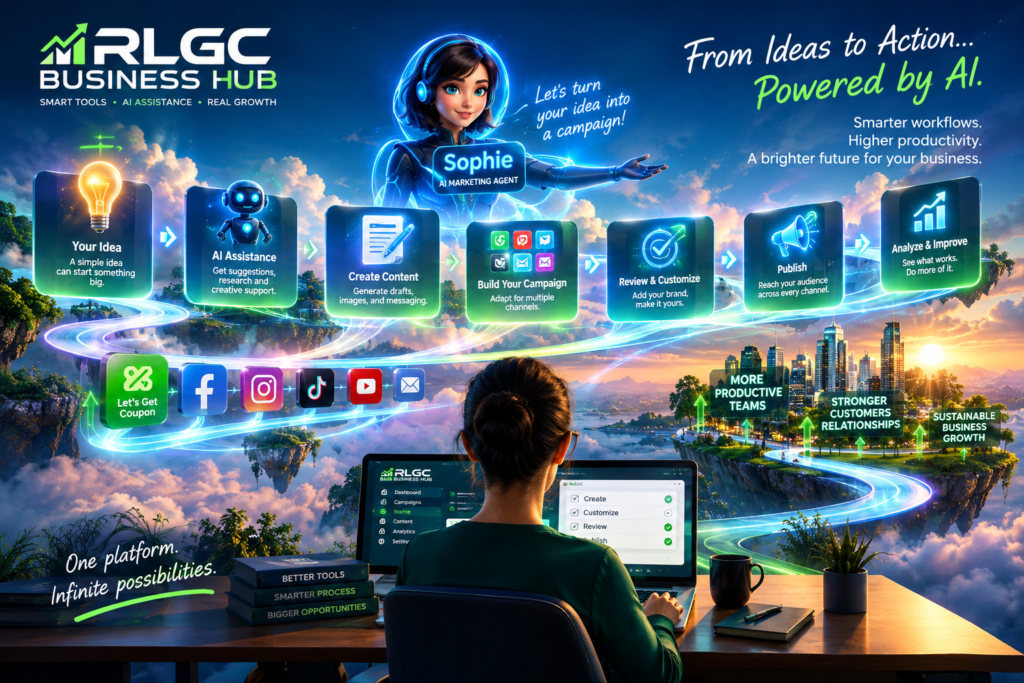
The larger opportunity is to help businesses use AI to turn ideas into completed business tasks.
For example:
Business Owner Has an Idea
↓
AI Helps Develop the Idea
↓
Create Marketing Content
↓
Create Campaign Materials
↓
Customize & Review
↓
Prepare for Publishing
↓
Measure & Improve
This is where an AI agent such as Sophie, the AI marketing agent being developed for RLGC Business Hub, can potentially become part of the workflow.
Instead of forcing a business owner to learn multiple complicated AI tools, the goal is to create an easier path from:
“I have an idea.”
to
“My campaign is ready.”
The Takeaway
AI’s biggest business opportunity may not simply be about generating text, images, or answers.
It’s about increasing the amount of productive work a company can accomplish with the resources it already has.
When implemented responsibly, AI can help businesses:
Work faster.
Reduce repetitive tasks.
Create more content.
Improve workflows.
Support employees.
Respond to customers more efficiently.
Turn ideas into action faster.
The companies that approach AI as a productivity and workflow technology, rather than simply a novelty, can begin looking at their operations differently.
The question isn’t just:
“What can AI create?”
It’s:
“What can our business accomplish when our people have AI helping them?
RLGC Business Hub — Building Smarter Business Workflows
You bring the idea. AI helps you build it.
With RLGC Business Hub’s developing AI capabilities and Sophie, the goal is to help businesses move from ideas to marketing campaigns and business content through a simpler, more connected workflow.
Work smarter. Create faster. Build better.