






How Artificial Intelligence Can Improve Forecasting, Operational Efficiency, and Decision-Making
Industry: Supply Chain & Logistics
Business Profile: Mid-sized distribution and logistics organization
Business Challenge: Increasing operational complexity, manual processes, inventory challenges, and limited real-time visibility
Technology Approach: AI-assisted forecasting, analytics, workflow automation, and decision support
Primary Objectives: Improve operational efficiency, increase visibility, reduce avoidable delays, and support better decision-making
Case study note: This is an illustrative business case designed to demonstrate how AI can be applied within supply chain and logistics operations. The operational results described are examples rather than reported results from a specific RLGC Business Hub customer.
Executive Summary
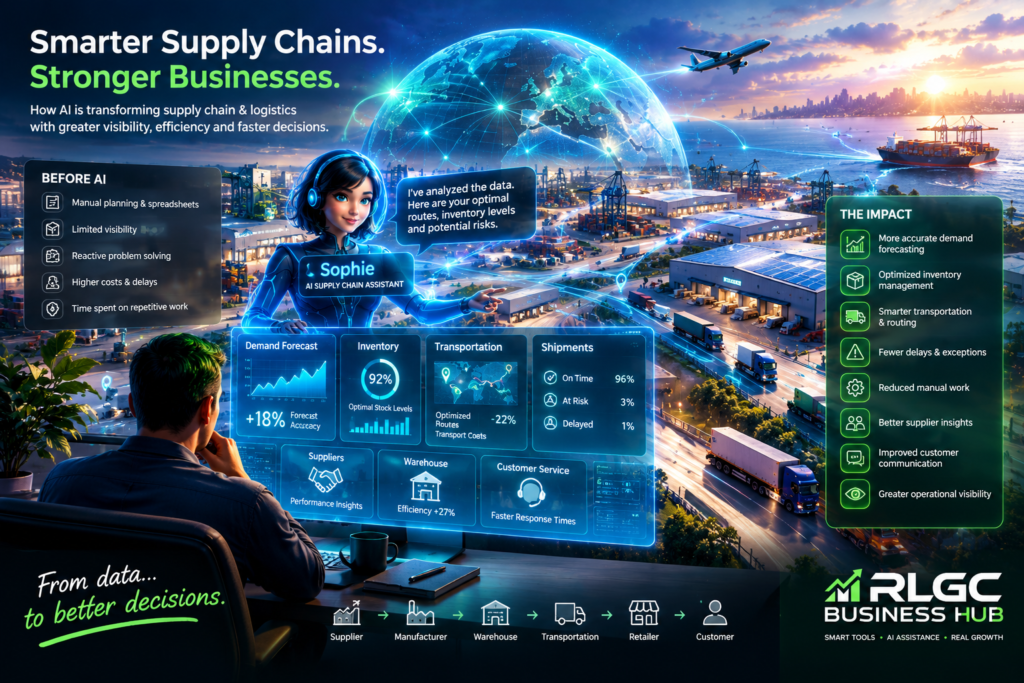
Supply chain and logistics organizations operate in an environment where speed, accuracy, cost control, and visibility are critical.
From procurement and inventory management to warehousing, transportation, and customer delivery, organizations must continuously make decisions based on large volumes of changing information.
Traditional processes can make this difficult.
Employees may rely on spreadsheets, historical reports, manual tracking, and disconnected systems to determine inventory requirements, monitor shipments, evaluate suppliers, and plan transportation.
Artificial intelligence introduces another approach.
Rather than relying exclusively on manual analysis, organizations can use AI to process large amounts of operational data, identify patterns, generate forecasts, automate selected workflows, and provide decision-support information to employees.
The potential result is a supply chain that is more data-driven, responsive, and efficient.
1. Business Challenge
The organization in this illustrative case study manages multiple suppliers, warehouses, transportation partners, and customer orders.
As operations expand, several challenges emerge.
Inventory Management
Demand varies across products and geographic markets, making it difficult to maintain appropriate inventory levels.
Excess inventory can increase:
- Storage costs
- Working capital requirements
- Product obsolescence
- Warehouse utilization
Insufficient inventory can contribute to:
- Stockouts
- Delayed orders
- Lost sales
- Customer dissatisfaction
Transportation Management
Transportation planners must coordinate numerous variables, including:
- Delivery locations
- Vehicle capacity
- Delivery windows
- Shipment priorities
- Driver availability
- Warehouse locations
Manual planning becomes increasingly difficult as shipment volumes grow.
Limited Operational Visibility
Management may have access to significant amounts of data but still face challenges turning that information into timely operational insights.
Administrative Workload
Employees may spend substantial time:
- Preparing reports
- Tracking shipments
- Updating records
- Reviewing inventory
- Communicating status updates
- Processing documents
This reduces the amount of time available for higher-value activities.
2. The AI Opportunity
The organization evaluates AI not as a replacement for its workforce, but as a technology layer designed to support employees and improve operational processes.
The implementation focuses on four primary areas:
1. Predictive Analytics
Use historical and current data to identify trends and support forecasting.
2. Workflow Automation
Reduce repetitive administrative activities.
3. Decision Support
Provide employees with relevant information and potential recommendations.
4. Operational Visibility
Identify exceptions and emerging issues earlier.
This approach allows the organization to introduce AI progressively rather than attempting to transform the entire supply chain simultaneously
3. AI-Assisted Demand Forecasting
Demand forecasting is one of the areas where AI can provide significant analytical support.
A traditional forecasting process may rely heavily on historical sales information.
An AI-assisted approach can evaluate multiple data sources, depending on the organization’s systems and data quality.
Potential inputs include:
- Historical demand
- Seasonal trends
- Sales patterns
- Promotional activity
- Inventory levels
- Lead times
- Regional demand
- Order history
The system can then generate forecasts or identify changes in demand patterns for supply chain professionals to review.
Operational Model
Business Data
↓
AI Analysis
↓
Forecast / Pattern Identification
↓
Supply Chain Professional Review
↓
Business Decision
The objective isn’t to allow AI to independently determine purchasing decisions.
The objective is to give decision-makers better information at the point of decision.
4. Inventory Optimization
Inventory management represents a significant operational and financial consideration for many organizations.
AI can assist by identifying unusual inventory patterns and potential supply-demand imbalances.
For example, an AI system could identify that demand for a particular product is increasing significantly within a specific region.
The supply chain team could then evaluate whether to:
- Increase replenishment
- Transfer inventory
- Adjust purchasing
- Modify inventory allocation
- Review supplier capacity
This allows the organization to move toward a more proactive inventory management model.
5. Transportation Optimization
Transportation planning involves numerous variables that can change throughout the day.
AI-assisted optimization can evaluate information such as:
- Shipment destinations
- Vehicle capacity
- Delivery requirements
- Existing routes
- Shipment priorities
- Available transportation resources
The objective is to help planners evaluate potential routing and scheduling options more efficiently.
Rather than manually comparing every possible scenario, planners can use technology to generate potential solutions and then apply their operational knowledge to select an appropriate course of action.
6. Predictive Exception Management
One of the most valuable applications of AI may be identifying potential problems before they become significant operational disruptions.
For example:
Traditional Process
Shipment delayed
↓
Employee discovers delay
↓
Customer is contacted
↓
Corrective action begins
AI-Assisted Process
Operational data changes
↓
AI identifies an unusual pattern
↓
Potential exception is flagged
↓
Employee investigates
↓
Corrective action begins
This approach shifts the organization from reactive management toward proactive exception management.
7. Warehouse Operations
AI can also support warehouse productivity.
Potential applications include:
- Inventory placement
- Order prioritization
- Picking optimization
- Replenishment planning
- Warehouse capacity analysis
- Labor planning
- Shipment preparation
For example, an organization could analyze order patterns to determine whether frequently ordered products should be positioned closer to high-traffic picking areas.
The decision remains operational, but AI can help analyze the information required to make it
8. Supplier Performance Analysis
Supplier reliability can have a direct impact on the broader supply chain.
AI can help organizations analyze supplier performance across areas such as:
- Delivery consistency
- Lead times
- Order fulfillment
- Product availability
- Historical performance
- Exception frequency
Rather than reviewing supplier information manually across numerous reports, procurement teams can use AI-assisted analytics to identify patterns that warrant investigation.
This can improve the organization’s ability to monitor supplier performance and manage potential risks.
9. Automation of Administrative Processes
Not every AI application needs to be complex.
Some of the most practical opportunities involve reducing repetitive administrative work.
Examples include:
- Shipment summaries
- Report generation
- Document classification
- Data organization
- Status updates
- Email drafting
- Information extraction
- Exception summaries
For example, an AI system could generate a daily operational summary for a logistics manager:
Daily Operations Summary
- Shipments processed
- Shipments in transit
- Delayed shipments
- Inventory exceptions
- Supplier exceptions
- Orders requiring attention
Instead of spending time assembling the report, the manager can focus on reviewing the exceptions and deciding what action is required.
10. Customer Service and Shipment Visibility
Customer expectations for shipment visibility continue to increase.
AI can support customer service teams by helping them access and communicate relevant shipment information more efficiently.
For example:
Order Status: In Transit
Current Location: Distribution Center
Estimated Delivery: Thursday
Exception: None
For an exception:
Order Status: Delayed
Reason: Transportation disruption
Updated Delivery Estimate: Friday
AI can assist with preparing communications while employees retain oversight for situations requiring judgment or customer-specific handling.
11. Illustrative Productivity Model
Consider an organization where employees collectively spend approximately:
| Activity | Monthly Hours |
|---|---|
| Reporting | 200 |
| Shipment tracking | 300 |
| Inventory analysis | 150 |
| Administrative tasks | 250 |
| Total | 900 |
If AI-assisted workflows eventually reduce the time required for eligible repetitive activities by 25%, the organization could potentially recover approximately:
225 employee-hours per month
Those hours could potentially be redirected toward:
- Exception management
- Supplier coordination
- Customer relationships
- Process improvement
- Strategic planning
- Operational analysis
This calculation is illustrative. Actual productivity improvements depend on implementation quality, process design, data availability, employee adoption, and the specific tasks selected for AI assistance.
12. Measuring the Business Impact
A professional AI implementation should be measured using business metrics rather than simply the number of AI tools deployed.
Potential KPIs include:
Supply Chain
- Forecast accuracy
- Inventory turnover
- Stockout frequency
- Order fulfillment rate
- Supplier lead-time variance
Logistics
- On-time delivery rate
- Transportation utilization
- Route efficiency
- Delivery exceptions
- Cost per shipment
Warehouse
- Order processing time
- Picking productivity
- Inventory accuracy
- Warehouse utilization
Workforce Productivity
- Administrative hours saved
- Report preparation time
- Exception resolution time
- Employee time redirected toward higher-value activities
Customer Experience
- Delivery visibility
- Customer inquiries
- Complaint volume
- Order resolution time
This measurement framework allows management to determine whether AI is actually improving the business rather than simply adding another technology layer.
13. Implementation Considerations
AI implementation should be approached carefully.
Data Quality
AI is only as useful as the information available to it. Inaccurate, incomplete, or inconsistent data can reduce the quality of its output.
Integration
AI systems may need to interact with existing:
- ERP systems
- Warehouse management systems
- Transportation management systems
- CRM platforms
- Inventory databases
Human Oversight
AI-generated recommendations should be reviewed appropriately, particularly when decisions involve significant financial, operational, or customer consequences.
Security
Supply chain systems contain sensitive operational and commercial information. Access controls, authentication, monitoring, and data governance should be part of the implementation strategy.
Employee Adoption
Employees need to understand how AI fits into their existing workflows. Successful implementation is as much an organizational change initiative as it is a technology project.
14. Strategic Impact
The broader opportunity is the transition from manual, reactive operations toward connected, data-driven decision-making.
Traditional Supply Chain
Data → Manual Analysis → Decision → Action
AI-Assisted Supply Chain
Data → AI Analysis → Human Review → Decision → Action
The difference isn’t necessarily the removal of human decision-makers.
It is the ability to provide those decision-makers with faster access to relevant information and analysis
Conclusion
Artificial intelligence has the potential to become an important component of modern supply chain and logistics operations.
Its value extends beyond automation.
AI can help organizations:
- Improve demand forecasting
- Identify inventory issues
- Support transportation planning
- Detect potential operational exceptions
- Automate repetitive administrative processes
- Analyze supplier performance
- Improve warehouse planning
- Support customer communication
- Give managers greater operational visibility
The most effective implementations are likely to be those that connect AI capabilities with clearly defined business objectives.
The goal isn’t simply to use more AI.
The goal is to build a more intelligent operation.
For supply chain and logistics organizations, that means using technology to help employees spend less time searching, compiling, and processing information—and more time analyzing, deciding, improving, and executing.
RLGC Business Hub Perspective
At RLGC Business Hub, we see AI as part of a broader shift toward smarter business workflows.
The opportunity extends beyond marketing and content creation. AI can potentially support businesses across multiple operational areas by helping transform information and repetitive processes into more efficient workflows.
Better information.
Smarter workflows.
Faster decisions.
More productive operations.