






How a Multi-Model AI Architecture Can Create a More Flexible, Efficient, and Scalable Business AI Platform
Industry: Business Technology / AI Platform
Organization Profile: Growing digital business platform
Business Challenge: A single AI model cannot efficiently handle every type of business task
Technology Approach: Multi-model AI architecture with intelligent routing and workflow orchestration
Primary Objectives: Improve AI task performance, optimize costs, increase flexibility, support multiple business functions, and create a scalable AI foundation
Case study note: This is an illustrative business scenario designed to explain the potential value of a Multi-Model AI Core. The results and performance figures are examples and should not be interpreted as results from a specific customer deployment.
1. Executive Summary
Artificial intelligence is no longer limited to a single type of task.
Modern businesses may need AI to:
- Generate marketing content
- Analyze data
- Write code
- Understand images
- Process documents
- Summarize information
- Create customer communications
- Generate videos
- Answer questions
- Automate workflows
- Perform specialized reasoning
A single AI model may be capable of performing many of these tasks, but that does not necessarily mean it is the optimal choice for every one of them.
This creates an opportunity for a different architecture:
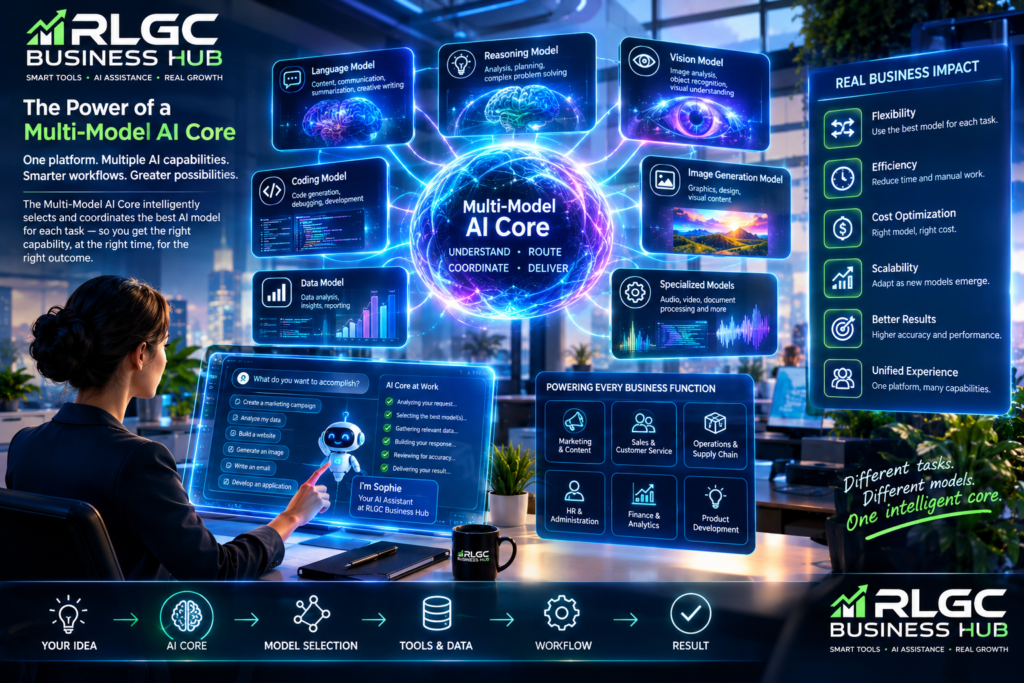
The Multi-Model AI Core
Instead of building an AI platform around one model, a Multi-Model AI Core acts as an intelligent orchestration layer that can connect multiple AI models and select the appropriate capability for a particular task.
The business user doesn’t necessarily need to know which model is being used.
They simply ask:
“What do you want to accomplish?”
The AI Core determines which combination of models, tools, data, and workflows should support the task.
2. The Business Challenge
Consider a growing business platform that wants to provide AI capabilities to its customers.
Customers may ask the platform to perform completely different tasks.
One customer might request:
“Write a promotional email for my restaurant.”
Another might ask:
“Analyze this spreadsheet and identify our best-selling products.”
Another:
“Create a social media campaign.”
Another:
“Analyze this product image.”
Another:
“Help me build a website.”
Another:
“Write code for this application.”
Each task has different requirements.
The challenge
Using one AI model for everything can create trade-offs involving:
- Performance
- Cost
- Speed
- Specialized capabilities
- Context requirements
- Accuracy
- Scalability
The organization therefore considers a multi-model architecture.
3. What Is a Multi-Model AI Core?
A Multi-Model AI Core is essentially an orchestration layer between the business user and multiple AI capabilities.
Instead of:
User → One AI Model → Response
the architecture becomes:
User → AI Core → Task Analysis → Model Selection → AI Model(s) → Tools/Data → Validation → Response
The AI Core determines which capabilities are appropriate for the request.
For example:
Marketing request
→ Language model
→ Marketing workflow
→ Brand information
→ Content generation
Data-analysis request
→ Reasoning/data model
→ Spreadsheet or database
→ Statistical analysis
→ Business summary
Image request
→ Vision model
→ Image analysis
→ Content generation
Coding request
→ Coding-capable model
→ Code tools
→ Testing/validation
→ Development output
This creates a more flexible AI platform.
4. The Architecture
A simplified Multi-Model AI Core could look like this:
BUSINESS USER
│
▼
┌─────────────────┐
│ AI CORE │
│ Orchestration │
└────────┬────────┘
│
Understands Request
│
┌─────────────────┼─────────────────┐
▼ ▼ ▼
Task Routing Model Selection Workflow Selection
│ │ │
└─────────────────┼─────────────────┘
▼
┌──────────────────────┐
│ AI MODEL LAYER │
├──────────────────────┤
│ Language Model │
│ Reasoning Model │
│ Vision Model │
│ Coding Model │
│ Image Model │
│ Specialized Models │
└───────────┬──────────┘
│
▼
┌───────────────────┐
│ TOOLS & BUSINESS │
│ DATA / SYSTEMS │
└─────────┬─────────┘
│
▼
VALIDATION & REVIEW
│
▼
RESULT
The important component isn’t simply the collection of models.
It’s the intelligence that coordinates them.
5. Intelligent Model Routing
One of the most important functions of the AI Core is model routing.
When a user submits a request, the system evaluates the task.
For example:
“Create a professional email campaign for our new product.”
The AI Core may determine that the task requires:
- Language generation
- Marketing instructions
- Brand information
- Customer information
- Campaign formatting
It can then route the task to the appropriate model and business workflow.
Another request:
“Analyze this sales spreadsheet and explain why revenue declined.”
The AI Core may route the task to a model optimized for reasoning and data analysis while connecting it to the uploaded spreadsheet.
The user doesn’t need to manage the complexity.
The system manages the complexity behind the scenes.
6. One Platform, Multiple AI Capabilities
The major business advantage is flexibility.
A Multi-Model AI Core can potentially support multiple AI capabilities through one platform.
| Business Requirement | Potential AI Capability |
|---|---|
| Content creation | Language model |
| Business analysis | Reasoning/data model |
| Image understanding | Vision model |
| Image creation | Image-generation model |
| Video workflows | Video-capable model |
| Software development | Coding model |
| Document processing | Document/vision model |
| Customer support | Language + retrieval |
| Automation | Agent + tools |
| Complex workflows | Multiple models |
The specific models can change over time without requiring the entire platform to be redesigned.
7. Cost Optimization
AI usage can involve different costs depending on the model and workload.
Not every task requires the most powerful model available.
For example:
Simple Task
“Rewrite this sentence.”
A lightweight model may be sufficient.
Complex Task
“Analyze these financial reports, identify trends, compare multiple periods, and explain potential causes.”
A more capable reasoning model may be appropriate.
The AI Core can potentially route each request according to its complexity.
This creates an important business principle:
Use the appropriate AI capability for the job.
Instead of automatically using the most expensive model for every request, the platform can potentially optimize model selection based on the task.
8. Performance Optimization
Different models can have different strengths.
One model may be particularly effective at:
- Fast responses
Another at:
- Complex reasoning
Another at:
- Coding
Another at:
- Image understanding
Another at:
- Creative generation
A Multi-Model AI Core allows an organization to combine these capabilities.
This means the platform isn’t necessarily dependent on the strengths or weaknesses of a single model.
9. AI Model Redundancy and Flexibility
A multi-model architecture can also reduce dependence on one AI provider or model.
AI technology changes rapidly.
New models can become available.
Existing models can change pricing.
Performance can improve.
Capabilities can evolve.
A platform built around a flexible AI Core can potentially introduce new models without completely rebuilding the customer experience.
Platform Layer
AI Core
↓
Model A
Model B
Model C
Model D
↓
Business Applications
This creates a more modular technology architecture.
10. Multi-Model AI for Business Workflows
The greatest opportunity may come from combining models rather than simply selecting one.
Consider a marketing campaign.
A business owner says:
“Create a campaign for our new restaurant promotion.”
The AI Core could potentially coordinate a workflow such as:
Step 1 — Understand the Request
Language/reasoning model interprets the objective.
↓
Step 2 — Develop the Campaign
Marketing-focused language generation.
↓
Step 3 — Create Visual Concepts
Image-generation capability.
↓
Step 4 — Create Social Content
Language model generates platform-specific content.
↓
Step 5 — Create Email
Marketing workflow generates email content.
↓
Step 6 — Review
AI evaluates consistency and completeness.
↓
Step 7 — Human Approval
Business owner reviews the campaign.
↓
Step 8 — Publish
Connected business platforms receive the approved content.
One business request can therefore become a multi-stage AI workflow.
11. The Role of AI Agents
A Multi-Model AI Core can become particularly powerful when combined with AI agents.
An agent can act as the orchestrator of a workflow.
For example:
“Prepare our monthly marketing campaign.”
The agent may determine that the task requires:
Reasoning → Content → Images → Data → Formatting → Review
Instead of asking the business owner to manually select individual AI tools, the agent coordinates the workflow.
This creates a shift from:
AI as a Tool
to
AI as a Workflow Coordinator
12. Example: RLGC Business Hub
This architecture aligns naturally with the type of platform RLGC Business Hub is developing.
Imagine a business owner enters:
“I want to promote a 20% discount for my restaurant this weekend.”
The AI Core could interpret the request and coordinate multiple capabilities.
Sophie
Acts as the business-facing AI agent.
↓
Marketing Intelligence
Determines campaign structure.
↓
Content Generation
Creates promotional copy.
↓
Image Generation
Creates supporting visual concepts.
↓
Social Media Workflow
Adapts the campaign for social platforms.
↓
Let’s Get Coupon
Creates the coupon/deal content.
↓
Email Workflow
Creates an email campaign.
↓
Review
Business owner reviews and modifies the campaign.
↓
Publish
Approved content is prepared for the selected channels.
The important concept is that Sophie doesn’t have to be tied to a single underlying AI model.
The Multi-Model AI Core can provide the intelligence layer underneath the experience.
13. Business Impact
A properly designed Multi-Model AI Core can potentially provide several business advantages.
Flexibility
Different models can be used for different tasks.
Scalability
New AI capabilities can potentially be added without rebuilding the entire platform.
Cost Management
Simple tasks can potentially use lower-cost models while complex tasks use more capable models.
Performance
Tasks can be routed to models that are well suited to the specific requirement.
Resilience
The platform can potentially reduce dependence on a single model provider.
Innovation
New AI capabilities can be integrated as the technology ecosystem evolves.
User Experience
Customers can interact with one unified AI interface rather than learning multiple AI tools.
14. Illustrative Business Scenario
Consider a platform handling 10,000 AI requests per month.
Suppose the requests are approximately:
| Request Type | Monthly Volume |
|---|---|
| Simple content tasks | 4,000 |
| Marketing campaigns | 2,500 |
| Data analysis | 1,500 |
| Image-related tasks | 1,000 |
| Complex reasoning | 700 |
| Coding / technical tasks | 300 |
| Total | 10,000 |
A single-model architecture might route every request through the same AI capability.
A Multi-Model AI Core could instead classify requests and route them according to complexity and requirements.
The potential business objective is:
Simple task → Appropriate lightweight capability
Complex task → More capable reasoning capability
Image task → Vision/image capability
Coding task → Coding capability
The exact financial benefit would depend on model pricing, token usage, infrastructure, routing accuracy, and workload characteristics.
15. Measuring Success
A professional Multi-Model AI implementation should be evaluated using measurable business and technical KPIs.
Performance
- Response time
- Task completion rate
- Model accuracy
- Workflow success rate
Financial
- Cost per AI task
- AI infrastructure cost
- Cost per customer
- Model utilization
Business Productivity
- Employee hours saved
- Tasks completed
- Campaigns created
- Workflows automated
User Experience
- Customer satisfaction
- User adoption
- Repeat usage
- Task completion without human intervention
System Reliability
- Error rates
- Model availability
- Failover performance
- Workflow recovery
16. Governance and Security
A Multi-Model AI Core also introduces additional governance requirements.
The organization needs to understand:
Where does the data go?
Different AI models may have different data-handling requirements.
Which model receives sensitive information?
The routing layer needs appropriate controls.
What information can each model access?
Access should follow the principle of least privilege.
How are AI outputs validated?
High-impact workflows may require additional review.
What happens when a model fails?
The system should have appropriate fallback and error-handling procedures.
Who is responsible for the final decision?
Human accountability must remain clearly defined.
These considerations become particularly important when AI is used in areas involving sensitive business information or consequential decisions.
17. The Strategic Advantage
The most important advantage of a Multi-Model AI Core may be architectural flexibility.
AI technology will continue to evolve.
Today’s strongest model may not be tomorrow’s strongest model.
A platform shouldn’t necessarily be designed around the assumption that one model will remain the best option indefinitely.
Instead:
The AI Core becomes the stable platform layer.
The underlying models can evolve.
RLGC BUSINESS HUB
│
▼
┌───────────────┐
│ AI CORE │
└───────┬───────┘
│
┌────────────────┼────────────────┐
▼ ▼ ▼
MODEL A MODEL B MODEL C
│ │ │
└────────────────┼────────────────┘
▼
BUSINESS WORKFLOWS
This creates a technology architecture that can adapt as AI capabilities change.
18. From Single AI to AI Ecosystem
The evolution can be viewed in three stages.
Stage 1 — Single AI
User → AI Model → Answer
Useful, but limited to the capabilities of one model.
Stage 2 — Multiple AI Models
User → Select Model → AI Model → Answer
More flexibility, but the user still manages the complexity.
Stage 3 — Multi-Model AI Core
User → AI Core → Understand → Route → Coordinate → Validate → Deliver
The platform manages the complexity behind the scenes.
This is where AI becomes less like an individual tool and more like an intelligent business infrastructure layer.
Conclusion
The future of enterprise AI may not be defined by a single model.
It may be defined by how effectively organizations can combine multiple AI capabilities into useful business workflows.
A Multi-Model AI Core can provide the architecture needed to:
- Select appropriate AI capabilities
- Coordinate multiple models
- Optimize costs
- Improve task performance
- Support different business functions
- Introduce new models over time
- Create intelligent workflows
- Reduce dependence on a single model
- Deliver a unified user experience
The strategic objective isn’t simply to have access to more AI models.
It’s to make those models work together.
For businesses, that means moving from:
One model → one task
toward:
Multiple models → one intelligent workflow.
RLGC Business Hub Perspective
This architecture represents an important opportunity for platforms such as RLGC Business Hub.
Sophie can serve as the business-facing AI agent while the Multi-Model AI Core operates behind the scenes.
A business owner doesn’t need to understand which AI model should handle a particular task.
They simply explain what they want to accomplish.
“Create a campaign.”
“Analyze my sales data.”
“Build a website.”
“Create an image.”
“Write an email.”
“Help me develop this application.”
The AI Core can determine which capabilities are appropriate and coordinate them into a unified workflow.
One interface. Multiple AI capabilities. Intelligent orchestration.
That is the potential of a Multi-Model AI Core.
RLGC Business Hub — Connecting AI capabilities to smarter business workflows.